Protect your PCB gold fingers from solder splatter and residue. Learn why polyimide (Kapton) tape is the industry standard, how to apply it correctly, and how to avoid common SMT masking failures.
Target Keywords: polyimide tape gold finger protection, Kapton tape PCB, gold finger masking tape, SMT high temp tape, PCB soldering protection
Gold fingers are the lifeline of your PCB. These gold-plated edge connectors ensure stable signal transmission between your board and external devices. But during manufacturing, they are incredibly vulnerable.A single speck of solder splatter, a scratch from handling, or chemical corrosion from flux can render a board useless.
At Hunan Lvzhimei, we see this failure mode daily. The solution? High-Performance Polyimide (Kapton) Tape. But not all tapes are created equal. This guide covers everything you need to know about protecting gold fingers during wave soldering, reflow, and conformal coating.
1. Why Gold Fingers Need Special Protection
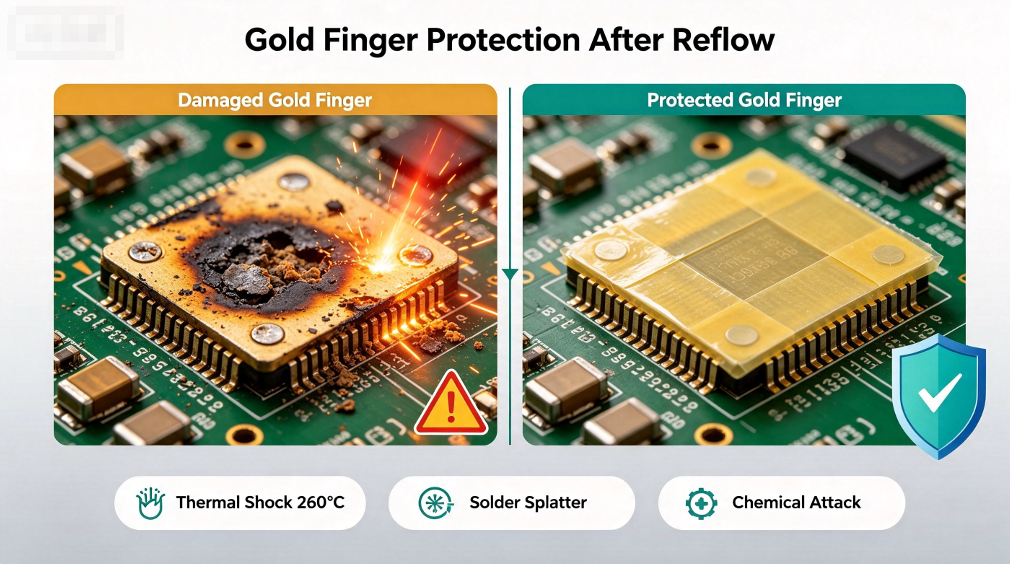
Gold fingers face three primary threats during assembly:
Thermal Shock: Reflow soldering peaks at 260°C. Standard tapes melt, shrink, or carbonize, exposing the gold.
Solder Splatter: Molten solder can bridge adjacent fingers, causing short circuits.
Chemical Attack: Flux residues and cleaning solvents can corrode the nickel under-plating or leave insulating residue.
2. Why Polyimide (Kapton) is the Industry Standard
Polyimide tape isn't just "heat resistant"; it's engineered for PCB survival:
Extreme Thermal Stability: Withstands 260°C continuous and short peaks up to 300°C without shrinking, wrinkling, or delaminating.
Chemical Inertness: Resists rosin fluxes, isopropyl alcohol (IPA), and plating solutions. It won't break down or leave sticky residue.
Electrical Insulation: H-Class dielectric strength prevents arcing between densely packed fingers.
Clean Removal: High-grade silicone adhesive ensures the tape peels off cleanly after the thermal cycle, leaving zero residue on the contact surface.
3. The #1 Cause of Failure: Residue & Bleed-Out
Even with Kapton tape, you can get residue. Why?
Wrong Adhesive: Using acrylic instead of silicone adhesive. Acrylic fails >200°C.
Overheating: Exceeding the tape's limit (e.g., >300°C for too long) causes the silicone to cross-link and bond permanently.
Hot Peeling: Removing the tape while the board is still hot. The adhesive is soft and weak; always cool to <50°C before peeling.
Tension: Stretching the tape during application creates internal stress. When heated, it shrinks and pulls adhesive off.

4. Best Practices for Gold Finger Masking
Follow this 6-Step Protocol to ensure zero defects:
Clean First: Wipe fingers with IPA to remove oils/fingerprints. Moisture causes bubbles.
Zero Tension: Lay the tape flat. Do not stretch. Use a squeegee to push out air bubbles from center to edge.
Precision Alignment: Align the tape edge 0.2-0.5mm inside the gold finger boundary. Never cover the solderable area or wick into vias.
Thermal Profile: Ensure your reflow peak stays within the tape's spec (e.g., <260°C for standard Kapton).
Cool Down: Let the board cool to room temperature. Never hot-peel.
180° Peel: Remove at a low angle, slowly and steadily.
5. Kapton vs. Alternatives for Gold Fingers
| Tape Type | Verdict for Gold Fingers | Reason |
|---|
| Polyimide (Kapton) | ✅ BEST | Survives 260°C+, clean removal, chemical resistant. |
| PET Tape | ❌ AVOID | Softens >180°C, edges lift, solder bleeds underneath. |
| PVC Tape | ❌ DANGER | Melts <80°C, leaves massive residue, releases toxic gas. |
| PTFE Tape | ⚠️ Niche | Good chem resistance, but poor adhesion/flexibility for fine-pitch fingers. |
6. LVMEI Gold Finger Protection Solutions
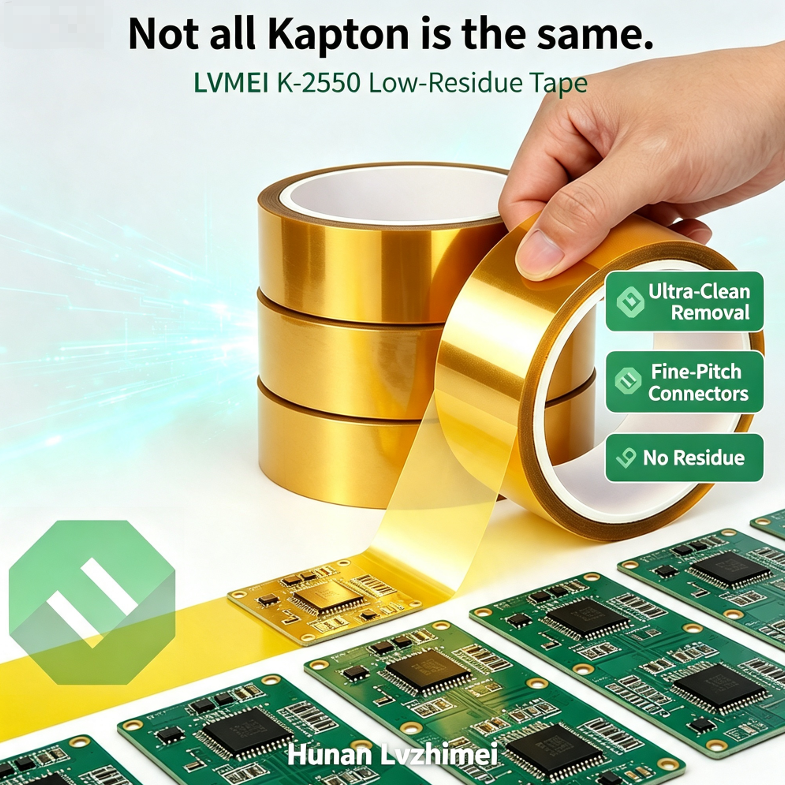
Not all Kapton is the same. Hunan Lvzhimei offers specialized formulations:
K-2540 Series: Standard 25μm film for general SMT masking.
K-2550 Low-Residue: Optimized silicone adhesive for ultra-clean removal on fine-pitch connectors.
K-5080 Heavy Duty: 50μm thickness for wave soldering or double-sided reflow.
Don't risk your yield on cheap tape.
👉 Get Your Free Gold Finger Masking Sample Kit Today!