Introduction: The Stakes of Battery Insulation
A battery cell with improper insulation tape isn’t just a quality issue—it’s a fire hazard. As lithium battery production scales globally, the demand for reliable polyimide tape has never been more critical. In the EV and energy storage sectors, a single insulation failure can lead to thermal runaway, catastrophic fires, and massive product recalls.
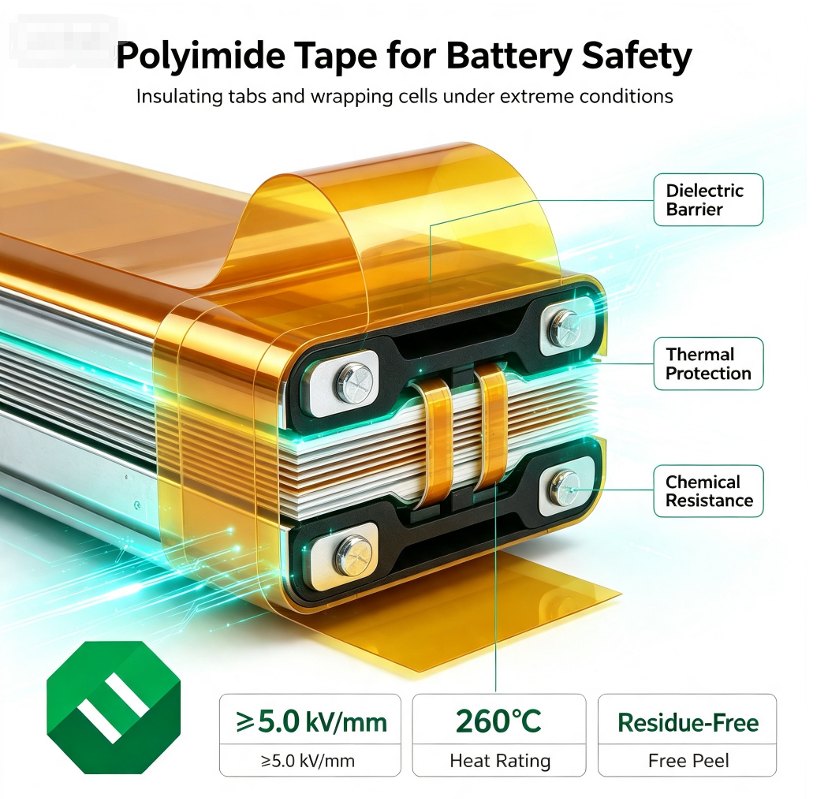
Polyimide (Kapton) tape is the unsung hero of battery safety. It provides the dielectric barrier, thermal protection, and chemical resistance necessary to keep millions of cells operating safely. This guide explores why battery manufacturing demands premium tape, the critical specifications you must verify, and how to ensure compliance with global safety standards.
Why Lithium Battery Manufacturing Needs Premium High�Temperature Tape
Battery manufacturing involves harsh chemicals, extreme temperatures, and precise mechanical stacking. Standard industrial tapes cannot survive this environment. Premium polyimide tape is required because:
• Electrolyte Resistance: Battery electrolytes are highly corrosive. Tape adhesives must resist chemical degradation over the battery’s 10+ year lifespan.
• Thermal Stability: Cells can reach 80°C+ during normal operation and much higher during abuse conditions. Tape must not melt or lose adhesion.
• Thickness Precision: In high-density battery packs, a 10μm thickness variation can cause stacking misalignment, leading to internal shorts or reduced energy density.
Key Applications in Battery Production
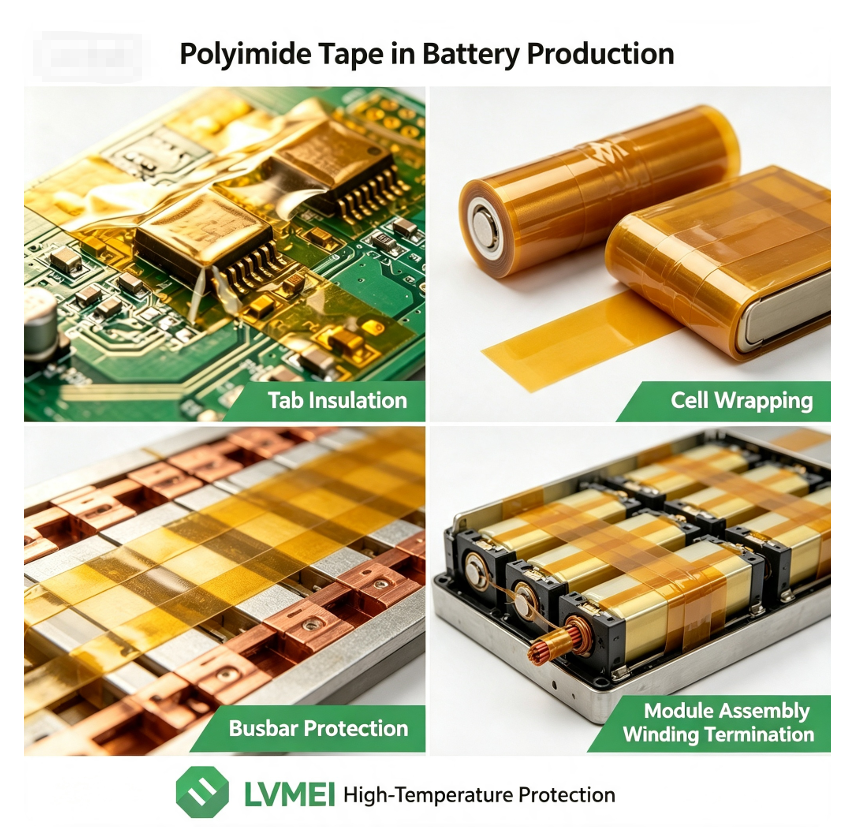
Polyimide tape is used at multiple stages of lithium battery manufacturing:
1. Cell Wrapping: Insulating the outer surface of cylindrical and prismatic cells to prevent short circuits with the metal casing.
2. Tab Insulation: Protecting the positive and negative tabs where they connect to the busbar. This is a critical high-stress point.
3. Module Assembly: Securing and insulating cells within the module frame.
4. Busbar Protection: Insulating copper/aluminum busbars to prevent arcing and short circuits.
5. Winding Termination: Securing the end of the electrode winding in cylindrical cells.
Critical Performance Requirements
When specifying polyimide tape for battery manufacturing, these are the non�negotiable parameters:
• Dielectric Strength: Minimum 5.0 kV/mm to prevent internal short circuits.
• Heat Resistance: Continuous use at 130°C-150°C, with short-term peaks up to 260°C during tab welding.
• Thickness Control: Tolerance of ±2μm for automated winding and stacking processes.
• Chemical Resistance: Must withstand exposure to LiPF6 electrolytes and NMP solvents without degradation.
• Flame Retardancy: Must meet UL94 V-0 or equivalent flammability standards.
Technical Specifications Comparison
LVMEI offers specialized polyimide tapes for battery applications. Below is a comparison of our most popular models:
Model | Thickness | Adhesion | Dielectric | Best Battery Application |
K-2540 | 40μm | 300 g/25mm | 5.5 kV/mm | Tab insulation, tight spaces |
K-2550 | 50μm | 400 g/25mm | 6.0 kV/mm | Cell wrapping, general insulation |
K-2560 | 60μm | 500 g/25mm | 6.5 kV/mm | Busbar protection, high voltage |
K-5080 | 80μm | 600 g/25mm | 7 |
|